For years, restaurant conversations about AI have centered on what the technology could do. Today's operators are asking a different question: What can it do for my managers right now?
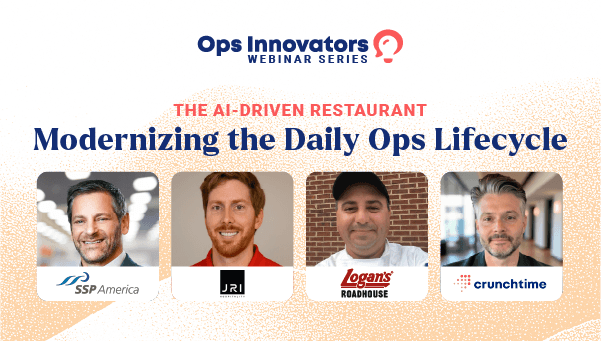
That was the focus of our latest Ops Innovators webinar, The AI-Driven Restaurant: Modernizing the Daily Ops Lifecycle, featuring leaders from SSP America, JRI Hospitality, and Logan's Roadhouse. While each organization is at a different stage of its AI journey, the panelists shared a similar perspective.
The most valuable AI isn't replacing jobs or chasing the latest trend. It's helping restaurant teams spend less time on administrative work and more time running great restaurants.
Let’s explore five key lessons from the session.
Lesson #1: If AI Doesn't Solve a Real Problem, It's Just Another Tool
Restaurant operators have no shortage of technology options. That's why AI has to prove its value quickly.
"If an AI tool can't reduce a manager's workload and deliver measurable ROI, it belongs in the 'interesting' category—not the investment category," said Todd Kaufman, Chief Information Officer at SSP America.
For Todd, the conversation starts with outcomes, not features. AI needs to help teams work more efficiently, make better decisions, or eliminate unnecessary work. Otherwise, it's simply adding another layer of complexity.
Bo Fairbank, Vice President of Analytics & Technology at JRI Hospitality, sees it similarly. "Adoption starts with value. If AI helps someone do their job better, they'll embrace it. If it creates more work, they won't," said Bo.
The takeaway? Operators aren't investing in AI because it's new. They're investing because they expect measurable operational results.
Lesson #2: More Data Isn't the Answer
Restaurant operators have more data than ever before. The challenge isn't collecting information. It's knowing what to do with it.
"The goal of AI isn't to deliver more data; it's to help teams make fewer, better-informed decisions," said Todd.
That idea surfaced repeatedly throughout the discussion. After years spent building reporting infrastructure and connecting systems, JRI Hospitality is now looking beyond dashboards and reports.
"With those data pipelines in place, I see the future moving beyond reporting and toward guided action," said Bo.
"Instead of simply highlighting a problem, AI can help explain why it's happening, recommend actions based on similar situations, and guide leaders toward the areas that will have the greatest impact," Bo added.
For restaurant teams juggling dozens of priorities every day, knowing what deserves attention can be just as valuable as the data itself.
Lesson #3: The Biggest Opportunity Is Giving Managers Time Back
When the panelists discussed where AI is making the biggest impact today, one theme rose above everything else: time.
"Every hour spent on administrative work is an hour that can't be spent coaching teams, ensuring food quality, or serving guests," said Michael Matos, Senior Director of Ops Services at Logan's Roadhouse.
That's why many operators are focusing their AI efforts on tasks like inventory, forecasting, scheduling, and reporting–areas that consume significant manager time but don't directly improve the guest experience.
"At Logan's Roadhouse, we see AI as a tool for reducing administrative work so managers can focus on leading their teams," Michael said.
The company has already reduced inventory counting time by 45-60 minutes per location with Crunchtime Inventory and is exploring additional savings through Crunchtime's voice-based inventory feature.
"As we pilot Crunchtime's voice-based inventory feature, we're excited about the potential to deliver another significant time savings for our teams," Michael said. The ultimate goal isn't automation for automation's sake–it's creating more opportunities for managers to lead, coach, and support their teams.
Lesson #4: Forecasting May Be AI's Most Practical Use Case Today
While AI's possibilities seem endless, the panelists pointed to forecasting as one of the clearest examples of immediate value.
Traditional forecasts often rely on historical sales and manager intuition. Today's AI-powered forecasting tools can incorporate factors like weather, seasonality, local events, and operational trends to generate more accurate predictions.
"Labor optimization and smart scheduling are huge focuses for us when it comes to using AI in our restaurants," said Bo.
As JRI Hospitality continues rolling out Crunchtime Inventory across its Freddy's Frozen Custard & Steakburgers locations, forecasting remains a major opportunity. "If we can deliver a more accurate forecast while reducing the time our teams spend building it, that's an easy win," Bo said.
The appeal is straightforward: better forecasts help restaurants make smarter labor and inventory decisions while reducing the administrative burden on managers.
Lesson #5: AI Can't Replace Hospitality
Perhaps the most important takeaway from the conversation was what AI isn't. None of the panelists talked about replacing managers, eliminating jobs, or removing people from the equation.
Instead, they described AI as a tool that helps restaurant teams perform at their best. "We're not looking at AI as a way to replace people. Hospitality is still a people business," said Bo.
Todd echoed the same sentiment. "At SSP America, AI provides focus and insight, but our people still make the decisions," Todd said.
That's ultimately where the industry's AI journey appears to be headed: not toward fewer people, but toward giving people better information, fewer administrative burdens, and more time to focus on guests.
The Next Chapter of Restaurant AI
The conversation around AI in restaurants is becoming more practical. Operators are moving past the hype and focusing on where AI can make a measurable difference: reducing repetitive work, improving decision-making, increasing consistency, and helping managers spend more time where they're needed most.
Because at the end of the day, the best AI doesn't replace great operators. It helps them be even better at what they already do.
Watch the full webinar today, or check out the AI Buyer’s Guide for Restaurant Ops Leaders.
.png)
![[Customer Spotlight] How Logan’s Roadhouse Uses Practical AI to Keep Managers on the Restaurant Floor](https://www.crunchtime.com/hs-fs/hubfs/Logans%20Spotlight.png?length=720&name=Logans%20Spotlight.png)
![[Webinar Preview] How Restaurant Leaders from 3 Top Brands Are Modernizing Ops with AI](https://www.crunchtime.com/hs-fs/hubfs/202605-OpsInnovators-June2026-1080_@2x%20(1).jpg?length=720&name=202605-OpsInnovators-June2026-1080_@2x%20(1).jpg)