One of the biggest ways restaurant leaders waste time and budget is by treating all AI like it’s the same. It’s not.
Some AI tools are built to predict what’s coming next. Others recommend what to do about it. Some are powerful but still early-stage for restaurant environments. And a few are already quietly driving measurable impact across labor, inventory, and forecasting today.
Understanding the difference isn’t technical; it’s operational. It determines whether AI becomes a competitive advantage or just another system your teams have to manage.
Here’s a simple way to break down the six major types of AI you’ll encounter when evaluating tools and what they actually mean for restaurant operations:
1. Predictive AI
-
What it does: Uses historical data to forecast what will happen next
-
Best use today:
-
Why it matters: This is one of the most proven, high-ROI applications of AI in restaurants today. It helps operators move from reactive decisions to proactive planning.
2. Prescriptive AI
-
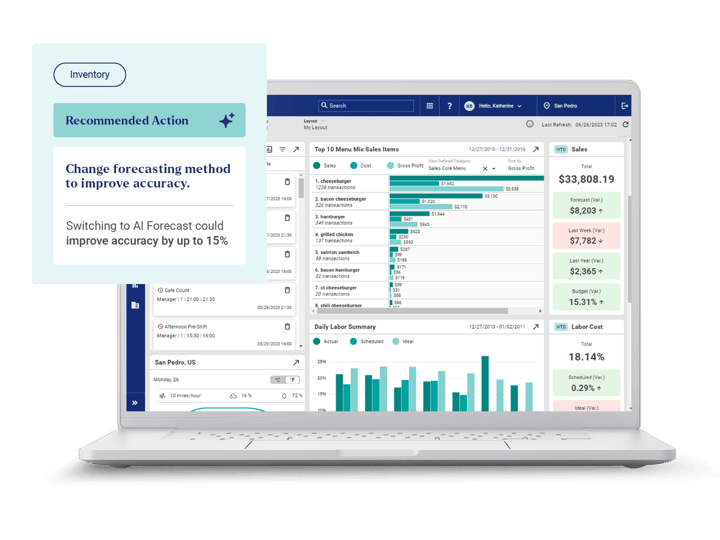
What it does: Recommends specific actions based on predictions
-
Best use today:
-
Staffing recommendations
-
Order quantities
-
Prep planning
-
Menu or bin optimization
-
Why it matters: This is where forecasting turns into execution. The real value comes when teams actually act on the recommendations consistently.
3. Descriptive/Analytical AI
4. Conversational/Generative AI
-
What it does: Produces text, answers questions, or assists with communication
-
Best use today:
-
Why it matters: Increases speed and accessibility of information, but outputs still need validation in operational settings.
5. Natural Language Processing (NLP)
-
What it does: Understands spoken or written instructions
-
Best use today:
-
Why it matters: Reduces friction in high-speed environments, but still requires oversight to ensure accuracy.
6. Agentic AI
-
What it does: Takes autonomous actions without human input
-
Best use today:
-
Why it matters: This is the most advanced (and least mature) category for most multi-unit restaurant operators today. It’s exciting, but not yet broadly scalable for everyday restaurant execution.
The Key Insight Most Restaurant Operators Miss
The biggest mistake isn’t choosing the “wrong” AI type; it’s choosing advanced AI before your operation is ready for it.
In high-turnover, high-volume environments, the most immediate value often comes from predictive and prescriptive AI working together:
-
Predictive tells you what’s likely to happen
-
Prescriptive tells you what to do about it
-
Your team executes with consistency
That combination is where measurable impact shows up fastest.
How to Evaluate AI Types for Your Operation
Before investing, pressure test every solution against these four questions:
-
Does this match a real operational priority (labor, inventory, forecasting, etc.)?
-
Is this technology proven in real restaurant environments, not just demos?
-
Can my team act on the output easily, without adding complexity?
-
Does the value show up today or only in a future roadmap?
If you can’t clearly answer those, the risk is high that the tool adds more noise than value.
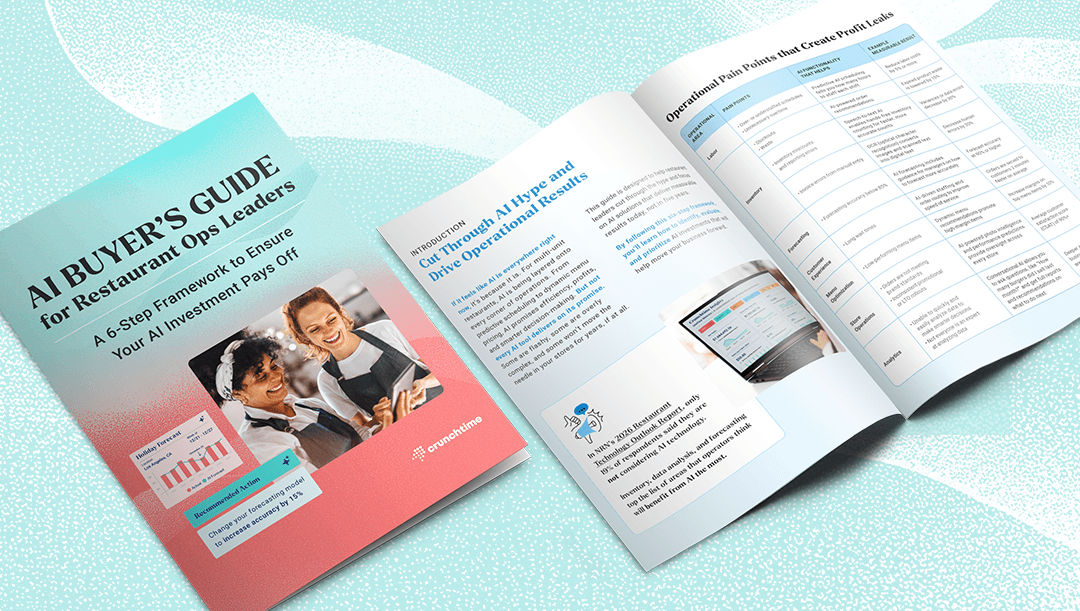
Understanding AI types is just one part of making smarter investment decisions. Our free guide walks through a full framework to help restaurant leaders evaluate, prioritize, and confidently invest in AI that actually improves operations. Download The AI Buyer’s Guide for Restaurant Ops Leaders to learn how to separate real impact from hype.